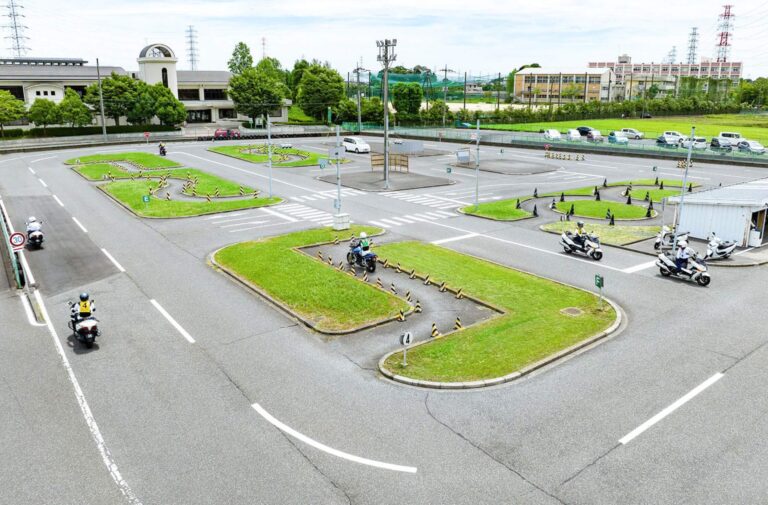
How to Get a Motorcycle License in Japan – PART 1 (License Types & Driving Schools)
Many foreigners are curious about how to get a motorcycle license in Japan. And I was surprised to find out that in the US, riders can learn how to ride from a friend. I got both my 400cc class and unlimited cc class license from local Japanese driving schools, so I wanted to share my experience.
License Types and Fees
It is broadly split into MT and AT, with 4 different cc classes (<50cc, <125cc, <400cc, unlimited). There are some differences in the test items, but in my opinion, the differences in difficulty level is not that big. Although from my experience attending classes, there are many students in all types of licensing classes.
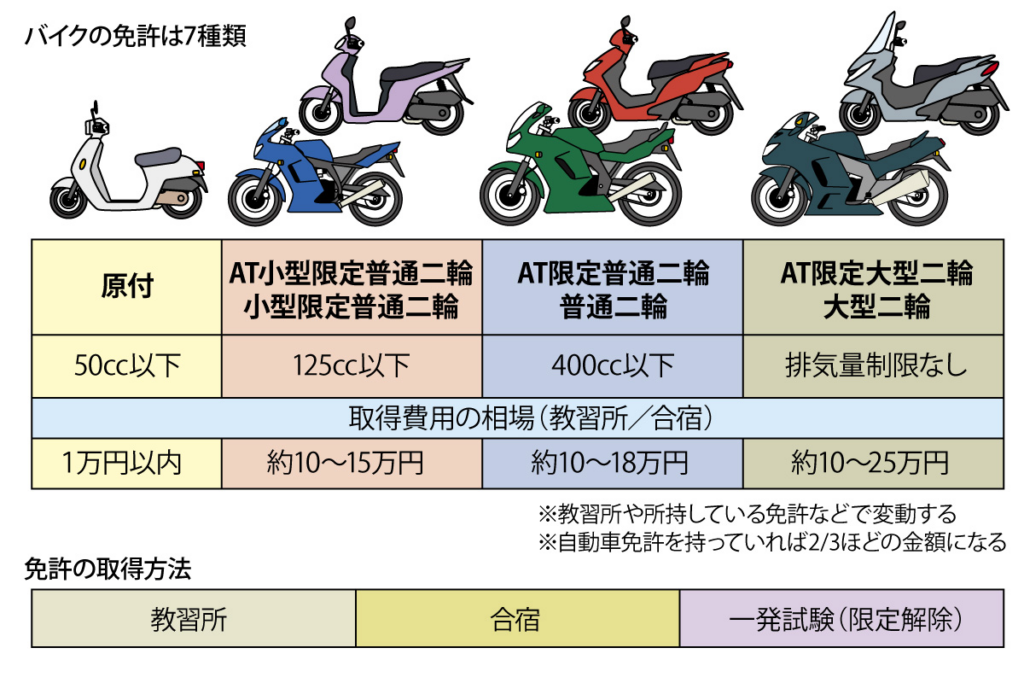
Source and credits: mynavi.jp
| icense Type | Eligible Vehicles | How to Obtain | Key Features |
|---|---|---|---|
| Moped License (≤50cc) | Motorcycles with engine displacement ≤50cc | 16 years or older Theory: 1 hour Practical: 2 hours Written exam only (no practical riding test) | • Easy to obtain • Legal speed limit: 30 km/h • Two-stage right turn required • Cannot ride on expressways |
| Small Motorcycle License (≤125cc) | Motorcycles with engine displacement ≤125cc | 16 years or older Theory: 26 hours Practical: 8 hours Theory and practical test | • Cannot ride on expressways • Good fuel economy and low running costs |
| Standard Motorcycle License (≤400cc) | Motorcycles with engine displacement ≤400cc | 16 years or older Theory: 26 hours Practical: 17 hours Theory and practical test | • Versatile license that covers most bikes • Can ride on expressways • Argubly enough for most of Japan |
| Large Motorcycle License (unlimited cc) | Motorcycles with no displacement limit | 18 years or older Additional practical: 12-14 hours Theory and practical test Can be obtained directly contrary to popular belief, no need for a standard license first | • Allows riding large-displacement bikes • The holy grail |
The Standard Motorcycle License basic fees range from JPY 140,000 to 190,000 for a student who does not have a driver’s license already (therefore including theory test lessons and practical riding license). And about JPY 120,000-140,000 additional for the Large Motorcycle License. However, you may find that the school is trying to extract more fees from you.
- Basic class fees and test fees: It is important to hightlight that the basic fees cover ONE lesson per “module”. It is calculated assuming that the student will pass the “module” and move on to the next (for example, G1 is hill start, G2 is emergency braking, G3 is crank test etc. More details to come in PART 2). So if a student is deemed not able to pass, they have to repeat the module, and that leads to more fees. Also, depending on the school, final examination fees may or may not be included in the quote (it is ~JPY 6,000-8,000 to take the exam and print the graduation certification).
- Repeat fees: It is usually ~JPY 5,000 / class to repeat an additional class . It is not allowed to skip a module, so one will keep doing the same thing until passing the module. Unfortunately, it is very common to fail “slalom test” and “plank test” for 2-3 times. You may say the fees the school post on their website is not really reflective of this.
- Insurance fees: this is not the typical injury or damage insurance we are thinking about, but insurance of passing modules — pay the price of 1-2 additional classes upfront to insure for potentially failing classes or the final test X number of times. I personally really recommend taking this if you are a real beginner, or have no confidence. In my experience and talking to the students at the school, most students fail modules 1-2 times, and it is very possible to fail the final exam ~1 time. If the school offers insurance option, it might be a cost saver at the end of the day.
- Advance booking (Accelerate program) fees of various ranges: For example, if you want to do advance booking of classes 2-3 weeks ahead because you want to ensure the graduation time, for such class packages the school may extract another JPY 20,000-50,000, depending on how accelerated you want to be. This is getting expensive but really necessary because in very crowded schools like Adachi riding school or Rainbow school, the normal plan only allows for booking 1-2 classes ahead. Students find that the next class will be at least 1-2 weeks later due to how crowded it is. In this case, it is easy to get rusty or forget certain techniques while waiting for their next class, leading to failing and having to repeat.
- English fees: Classes that are not in Japanese are often 10%-15% more. It is understandable as usually the teacher can cover 4-5 students per class but English classes are usually 1-2 students only per class.
Driving school types
There are two types of driving schools in Japan: (1) normal driving school, and (2) driving camps. For both types of school, a student has to take both the riding test and the written test (if you do not already have a driver’s license). I will focus on the riding test.
Normal certified driving schools are class schedule-based, therefore a bit slower, and slightly more expensive. There are schools with instructors who can teach in languages other than Japanese (English, Chinese), and more suitable for students who do not have flexible schedules, or prefer to learn at their own pace.
Time it takes to complete a course: depending on your availability, the shortest time can be down to 2-3 weeks if you can take class everyday.
Examples:
- Koyama Driving School: has multiple locations and offer English/Chinese course
- Rainbow Driving School: has multiple locations, but in Japanese only
- Adachi Driving School: only one location but very conveniently located
For people who live inside Tokyo, you may find that most of the driving school that offers English language only do so for 4-wheelers. And you may have to travel outside to Saitama-ken for motorcycle license.
Driving license camps are for a short 2-3 weeks of stay, and get the driving license by the end of the stay. They are usually cheaper even considering the campus fee and transporation cost. This option is suitable for students who are somewhat already confident, want to get license fast, and do not mind spending a few days in the mountain. Also it is usually in full Japanese.
- Gasyukumenkyo: this website offers reviews of multiple license camps location around Tokyo with commentary from students, including price and quality.
- It is funny because some of the locations are becoming local tourism destinations. For example Goikyo driving school is marketing on-site onsen facilities for students
Direct testing is also possible by going to the testing center without attending school. It is supposedly cheaper because there is no “class-fee” and only “test-fee”. But, from conversations with Japanese riders, almost no one has gotten their license (at least <400cc class) through this path!
- The test examiners are very strict and minus points on every mistake, whereas in the driving school tests, they sometimes allow small mistakes to pass
- Unfamiliar with the test bike, this is the biggest one for me. The test bikes are specific bikes that are equipped for testing/learning, and not easy to get use to for even seasoned riders
- Unfamiliar with the test items and routes to take, even for seasoned riders, the slalom test and plank test is hard to pass in one-go for the first time
- Time to retest is super long and no shortcuts. It can take 1-2 months between test dates if you unfortunately failed once, which is enough time to go through the normal certified driving school route. And if the driving school knows that you are already on the direct test route, sometimes it can complicate your application.
Teaching Bikes
Japanese riding school bikes are specifically equipped with crash guards, sliders, and riding indicators (to show speed, brakes and gear lights to the instructor/examinar). This helps the instructors understand what the student is doing without having to yell at them.
However, this also means that the bikes are almost 10-20kg heavier than the commercially available option of these motorcycle models, and really requires the student to be equipped with skills to handle a heavy motorcycle.
Some examples and more on this later:
- The 1st gear is orange, 3rd gear is blue etc. There are specific parts of the course that requires the student to be in a specific gear, so the instructor can see easily.
- For the emergency brake test, students are required to be >40km/h before the brake zone, and the white light will flash upon attaining speed.
For <400cc license, you will be required to ride a 400cc teaching bike that is now the NX400L.
This is a model modified based on the commercially available crossover model NX400:
- Water-cooled inline 2-cylinder, 399cc engine.
- Modified with changes to the handlebar shape, and improved handling in the low to medium speed range (<40km/h) that is used in the driving school
- The vehicle weight is 200kg is not too intimidating, but heavier than the commercial NX400
- Seat height of 790cm is also designed to be approachable
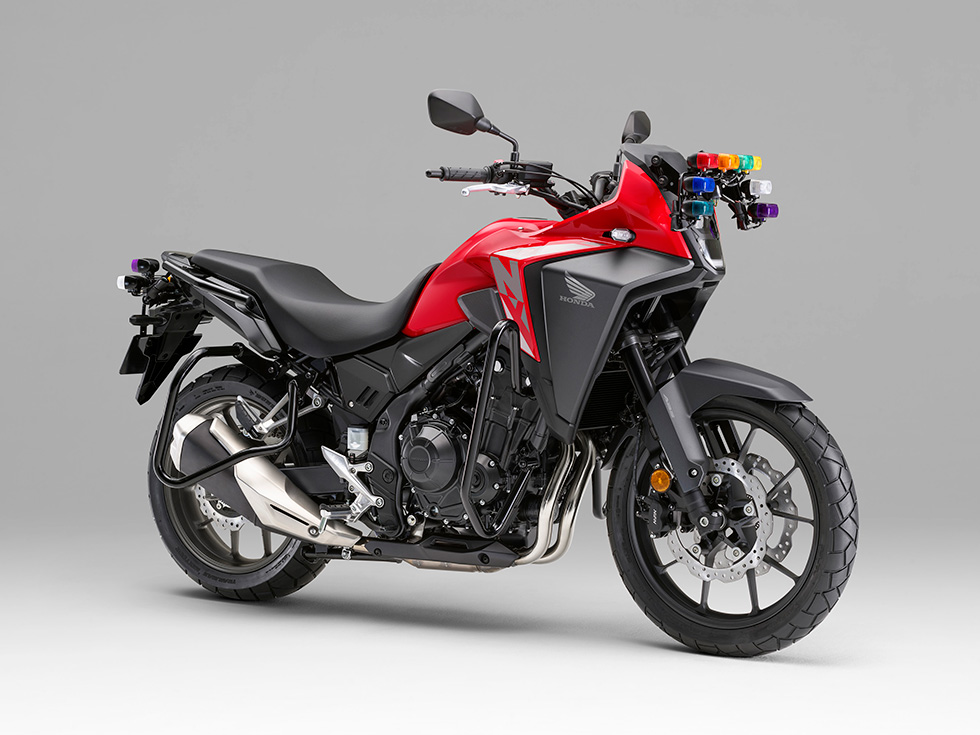
Source and credits: Honda
The unlimited bike license uses the NC750L, which is a modified NC750.
- Water-cooled inline 2-cylinder, 745cc engine. But similar to the NX400, the engine is nerfed to accomodate low speed riding
- The vehicle weight is 220kg!
- Seat height of 793cm
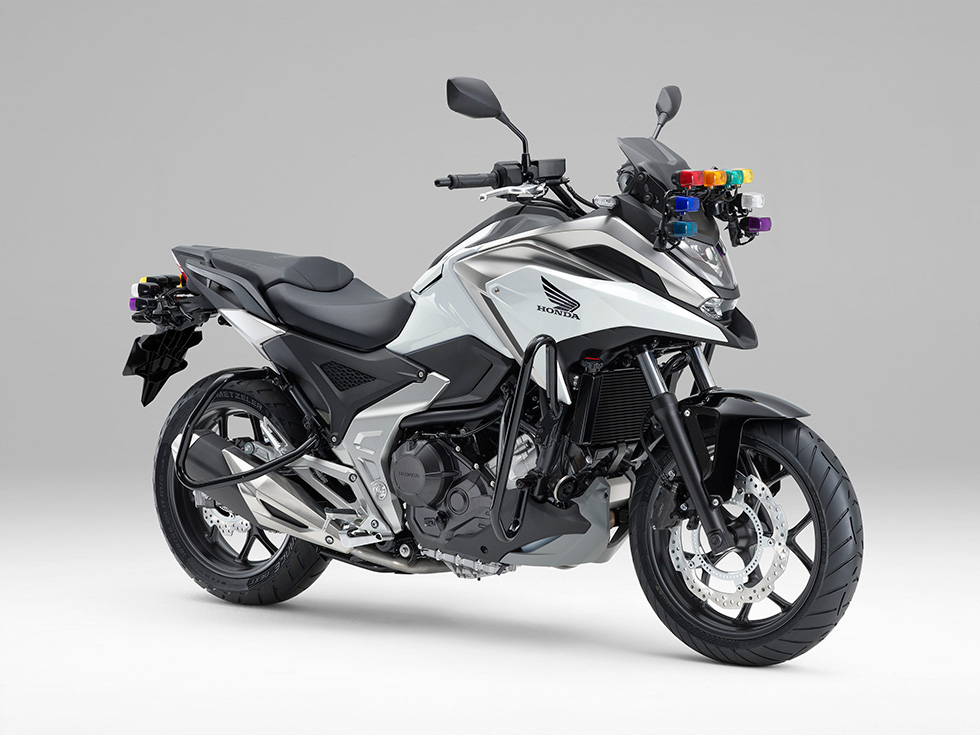
Source and credits: Honda
When I was a student, I was lucky enough to be on the last legs of the CB400 SUPER FOUR teaching bikes. Even though they probably have had multiple repairs and are mostly in terrible conditions, I miss those bikes very much.
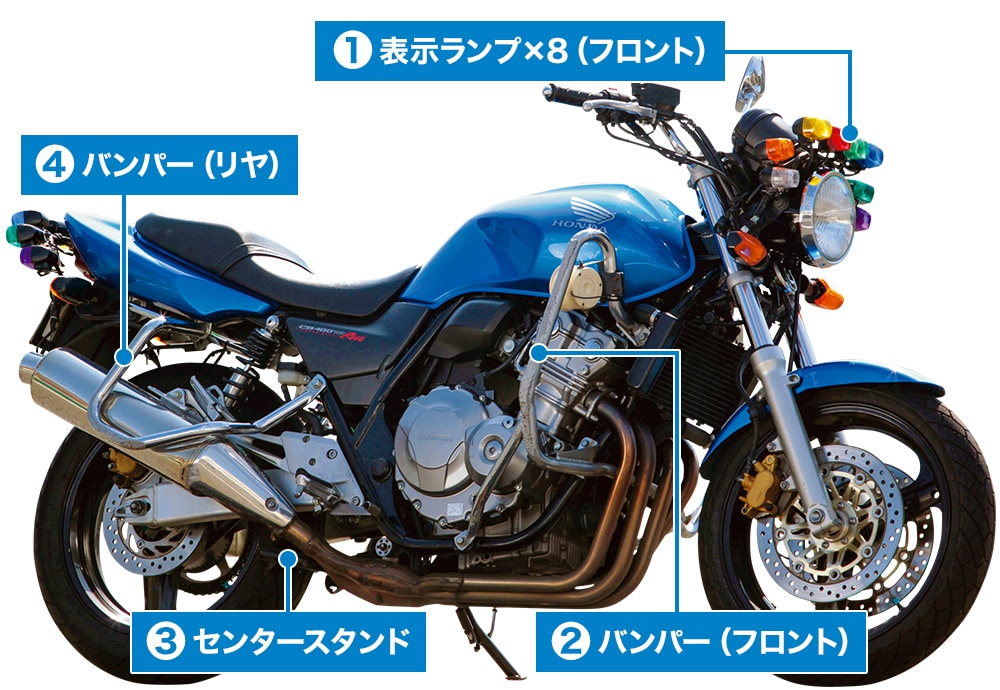
Source and credits: Tandem Bike
Day ONE Test
The reason why size, seat height, and weight matter is because during the 1st day of class, all students are required to conduct a drop-and-pick up test. Including small girls who are ~150cm and weigh no more than 40kg are required to pick up a laid down NX400 or NC750.
The method to pick up is using the front push method. We cannot use any other method (like using the squat method) to pick up the bike. This video shows the right method taught by Japanese school, and also as a screening test on the 1st day.
Next, we have to put push the motorcycle from the parking lot to the starting line, and then put a ~200kg motorcycle on the center stand.
Students who are not able to do that with zero assistance are not allowed to take the motorcycle class. This is before we even get on the road… It is really harsh for girls who are not strong, or even familiar with the weight and balance of the bike. I have seen some girls failed at this and have to give up, or come back again.
From this video, you can see the Japanese motorcycle schools method to pick up a fallen bike.
Part 2
After proving that we are strong enough and worthy of riding a motorcycle, we can finally enroll in the motorcycle course. We will receive booklets of education that teaches on paper the right riding posture, and methods of conquering each of the motorcycle test items.
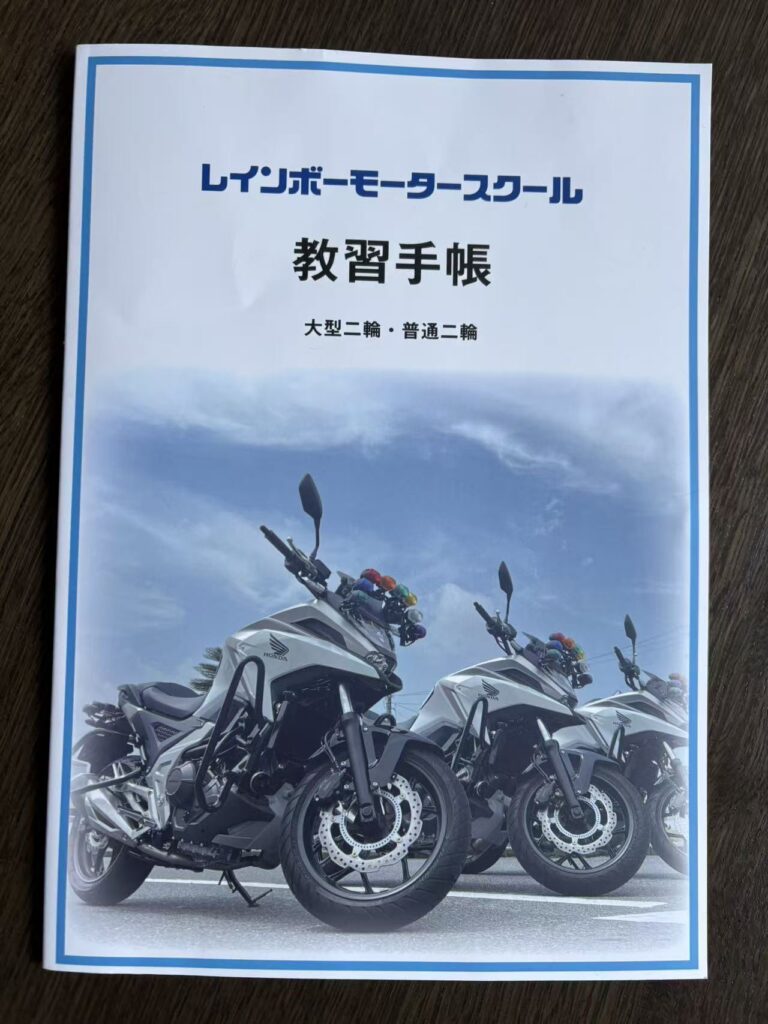
Next, I will talk about what items are in this book, aka the riding test items, like plank, slalom, crank-turning, and figure-8 in PART 2. So please stay tuned!
Getting your license? Don’t guess your gear size.
While I am not a strong proponent of ATGATT, it is very easy to get injured as a new rider. Most new riders in Japan end up buying the wrong size — especially when ordering online or switching between brands.
On Hanami Bike, I break down for ladies:
- Which motorcycle gear brands run small or large
- Real-world fit insights from riders
- A smart sizing tool to get your best fit instantly
👉 Start here:
HanamiBike Women Gear Sizing Guide